
 Workato
 Azure
Azure MuleSoft
 Salesforce
 AWS
AWS


Global research organization working to improve people’s lives, protect nature, and stabilize the climate, with work spanning forests, freshwater, energy, food, cities, and climate policy across regions on every continent.
wri.org ↗Enterprise integration and process automation partner, helping organizations connect systems and automate processes — with deep Workato and Workday integration expertise.
apipeople.com ↗Enterprise automation and iPaaS platform whose recipe architecture and native Workday connector depth made the integration logic explicit, testable, and maintainable by WRI’s own team.
workato.com ↗THE CHALLENGE
For Steve Skripek, Principal and Workato Practice Director at API People, every integration engagement starts with the same question: how much time do we actually have?
For the World Resources Institute, the answer was eight weeks. Not because the project had been scoped that way, but because a lengthy acquisition cycle had consumed the runway that would otherwise have gone to planning. By the time the engagement was formally underway, WRI’s Workday go-live date was fixed, immovable, and close.
WRI is a global research organization working to improve people’s lives, protect nature, and stabilize the climate. Their work spans forests, freshwater, energy, food, cities, and climate policy across regions on every continent. Grants and contracts are not revenue in the conventional sense. They are the funding mechanism for research that shapes policy at a planetary scale. Getting the systems that track that funding right, and getting them right on time, was not a project milestone. It was an operational necessity.
What the team had to build in eight weeks was a bidirectional integration across six object types, spanning customers, sponsors, contracts, grants, award schedules, and awards, connecting a Salesforce environment that managed the full funding lifecycle to a Workday instance that had never yet processed a single transaction.
It was delivered on time and in full. Here is how.
THE CHALLENGE
The deadline that could not move
Workday go-live dates are not suggestions. They represent months of configuration, training, data migration, and organizational change management. Missing one is not a project setback. It is an institutional event.
For WRI, the stakes were especially concrete. Grants and contracts fund active research programs, researcher salaries, field operations across multiple continents, and donor commitments that carry their own reporting obligations. A Workday launch without a working integration did not mean a delayed feature. It meant manual processes filling the gap at exactly the moment the organization was standing up a new financial system of record.
The acquisition process that delayed the engagement start was nobody’s fault. Procurement cycles at institutions of this type are thorough by design. But thoroughness has a cost, and in this case the cost was time that would normally have been used to scope the integration, align on data models, and establish the mapping logic before a single recipe was built. Discovery, design, and delivery would have to run in parallel, and the margin for revisiting decisions was narrow.
“A fixed go-live date changes how you work. You do not have the luxury of sequential phases. Discovery and build have to happen at the same time, which means the team has to hold ambiguity in one hand and make confident decisions with the other. That is a different kind of discipline than a project with flexible timelines.”
— Steve Skripek, Principal, Workato Practice Director, API People
THE SOLUTION
Why Workato, and why API People
From API People’s perspective, Workato was the right platform for this engagement for reasons that went beyond connector availability. The integration required conditional routing logic that had to be precise: the same Salesforce stage change routes to entirely different Workday objects depending on whether the opportunity is expected to result in a grant or a contract. That kind of branching logic, applied correctly, is invisible to the end user. Applied incorrectly, it creates compliance exposure. Workato’s recipe architecture made the logic explicit, testable, and maintainable by WRI’s team after delivery.
The platform’s Workday connector depth also mattered. Workday is not a system that tolerates loose integrations. Its object model is structured, its APIs are specific, and errors in record creation, particularly for financial objects like awards and award schedules, carry downstream compliance implications. Workato’s native Workday support gave the team a stable foundation to build on without engineering low-level API handling under time pressure.
For an organization of WRI’s scale, operating across multiple regions and funding vehicles, the ability to build sophistication into the integration without building a dedicated internal integration team to maintain it was equally important. Workato made that possible. API People came to the engagement with deep Workday integration experience and a delivery model built for exactly this kind of situation: complex scope, compressed timeline, and a client team that needed a partner willing to own the outcome.
THE BUILD
What had to be built
The integration scope covered six object types, each with its own directional logic, trigger conditions, and field mapping requirements. Together they represent the full lifecycle of a funded research engagement at WRI, from initial customer and sponsor records through to executed awards and payment schedules.
The complexity was not evenly distributed. Some flows were relatively contained. Others required careful design, and one in particular carried enough data volume and compliance weight to define the engagement’s risk profile on its own.
- Customers and Sponsors. Both flow bidirectionally between Salesforce and Workday, triggered three times daily on a 24/5 schedule. The trigger is the same stage change in Salesforce, but routes to different Workday objects depending on the expected outcome: customers when the result is a contract, sponsors when it is a grant or cooperative agreement. Workday returns a reference ID on creation, which flows back to Salesforce to identify the record for all future transactions. This handshake is foundational. Every downstream object depends on it being correct.
- Customer Contracts and Grants. Contracts flow from Salesforce to Workday on creation. Grants insert into Workday as draft records, available for staff review and completion before being finalized. That design reflects how grants administration actually works at an organization like WRI: the system of record captures intent, but experienced staff judgment remains part of the process before a grant is formally committed.
- Award Schedules. Created one record per grant, flowing from Salesforce to Workday as drafts. Ten core values on each record, structured to support the staff workflow in Workday rather than bypass it.
- Awards. The most data-intensive object in the integration, with thirty values flowing from Salesforce to Workday on creation and a reference ID returning to Salesforce on completion. Awards represent the formal financial commitment of a funded research engagement. At WRI, where a single award may fund multi-year, multi-continent research programs, the mapping logic was built with that weight in mind. Errors here are not data quality issues. They are compliance events.
THE BUILD
Integration workflow: Salesforce to Workday
Numbered by data dependency, not by schedule: a customer or sponsor has to exist before a contract or grant, and a grant before its award schedule and award. Each flow still runs on its own trigger, independently of the others.
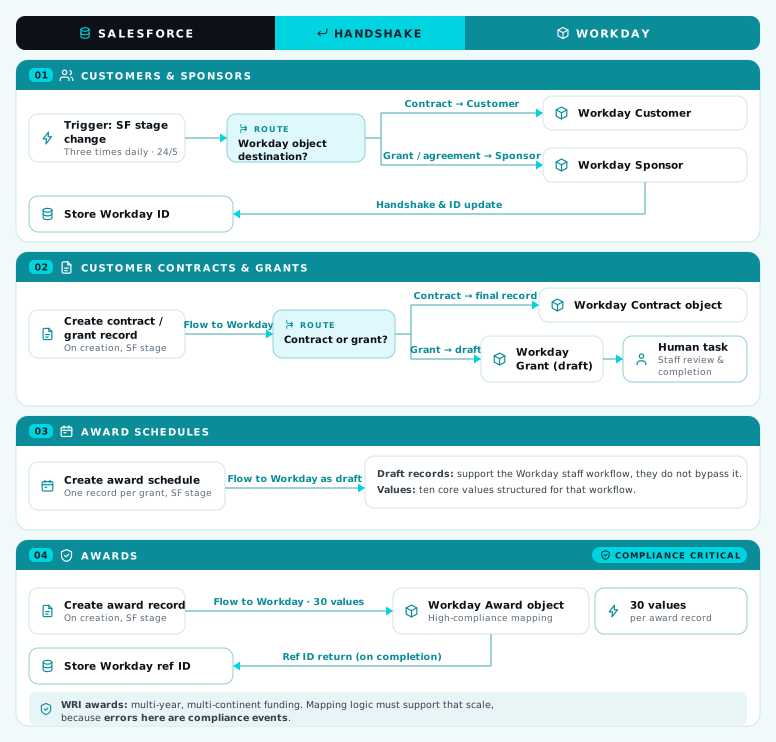
Across all six object types, the bidirectional flows share a common pattern: Salesforce initiates, Workday processes and assigns a reference ID, and that ID returns to Salesforce to close the loop. Demanding in execution, because the rules governing when each direction fires, what data it carries, and how errors are handled had to be defined from scratch, in parallel with the build, against a deadline that was not moving.
“The integration architecture for grants management looks straightforward on a whiteboard. Six objects, two directions, one platform. What the whiteboard does not show is the conditional routing logic, the reference ID handshakes, the draft record patterns for staff review, and the thirty-field Awards mapping that has to be right the first time. That is where the real work lives, and at WRI, getting it wrong was not an option.”
— Steve Skripek, Principal, Workato Practice Director, API People
THE BUILD
Building under pressure
Eight weeks is enough time to build a well-scoped integration. It is a tight window for one where the scope is still being defined as the build progresses, and where the underlying business rules are being formalized for the first time in a system that had not previously existed.
API People’s approach was to establish the structural patterns early and let the field-level detail fill in around them. The bidirectional reference ID handshake, the conditional trigger routing, and the draft record pattern for grants and award schedules were architectural decisions that, once made, created a stable frame for the rest of the build. Individual field mappings could be added, adjusted, and extended without touching the core logic.
That approach also created resilience against mid-build discoveries. As the team worked through each object type in detail, edge cases emerged. Trigger conditions needed refinement. Field mappings that looked clean in Salesforce required transformation before Workday would accept them. Revenue recognition timing had to be handled carefully: a grant or contract could sit for weeks between quote and payment, and booking revenue at the point of quote creation was not financially appropriate for an organization with WRI’s reporting obligations. The integration had to respect that boundary by design.
WRI’s willingness to make decisions quickly was equally important. Integration design at this pace requires a client team that can align stakeholders and sign off on tradeoffs without lengthy approval cycles. That alignment was present throughout the engagement, and it made the difference between hitting the date and missing it.
THE RESULTS
What WRI gained
Workday went live on schedule, with the integration already in place and processing transactions from day one. The outcomes were felt immediately across the organization, and the engagement did not end at go-live.
- On-time go-live. Workday launched on the committed date with all six integration flows live, tested, and stable. No manual handoff period, no post-launch reconciliation backlog.
- Full lifecycle automation. Every stage of WRI’s funded research lifecycle, from customer and sponsor creation through to executed awards and payment schedules, now flows automatically between Salesforce and Workday without manual intervention.
- Teams working in their own systems. WRI’s development and grants teams manage the full funding lifecycle in Salesforce without needing Workday access. Workday receives clean, structured data without depending on manual entry from the front-end team.
- Compliance-ready from day one. Award records were built with auditability as a design requirement. The integration enforces data integrity and revenue recognition timing at the point of creation, not after the fact.
- A managed services relationship. Following go-live, WRI engaged API People on a managed services contract to maintain and enhance the integration on an ongoing basis. The same team that built the integration under pressure is now responsible for keeping it current as both the Salesforce and Workday environments evolve.
THE PARTNERSHIP
The relationship that outlasted the deadline
The managed services engagement that followed go-live is, in some ways, the most important part of this story. It reflects something easy to overlook when the narrative focus is on delivery: an integration is not a project. It is infrastructure. It needs to be maintained, monitored, and extended as the organization evolves around it.
For an organization of WRI’s scale and complexity, operating across multiple regions, funding vehicles, and research programs, having a partner with full context on the integration is an operational necessity. When Salesforce releases an update that affects a trigger condition, or when Workday changes an API response format, or when WRI adds a new funding structure that needs to flow through the system, the team that knows the architecture is already in place and already accountable.
That continuity is by design. API People builds integrations to be owned and extended, not to create dependency. When a client of WRI’s scale and mission moves into managed services, it speaks to something beyond a successful go-live.
“API People made integration of our Salesforce and Workday environments not only possible but enjoyable! Prior to partnering with API People, we struggled to build the integration in-house. API People’s experts unlocked the potential of the iPaaS investment WRI had already made and helped upskill our in-house team. They were a pleasure to work with from procurement through implementation and iteration. API People’s excellent customer service has been a big contributor to our successful collaboration. Responses are very quick while still providing a thorough, detailed analysis.”
— Luisa Gelfand, Salesforce Associate Director, World Resources Institute
THE LESSON THAT TRAVELS
Grants management at a global research institution is a domain where the stakes of integration failure are unusually concrete. A misconfigured Award record does not produce a data quality issue. It produces a compliance event. A sponsor that does not sync correctly does not create a reconciliation problem. It creates a gap in the financial record of a research commitment that may span years and continents.
WRI’s tagline is Count It, Change It, Scale It. The integration API People built speaks to all three, starting with the partnership itself. WRI needed a partner they could count on, not just a vendor who could stand up connectors under pressure. That partnership helped WRI envision the change they needed, a funding lifecycle that moves between Salesforce and Workday without manual handoffs or added headcount. And it built the architecture to scale that change, extending as WRI’s regions, funding vehicles, and research programs grow.
The deadline could not move. Everything else had to.
FAQs
1. How long did the WRI Salesforce-Workday integration take to build?
API People delivered the full integration in eight weeks, with the Workday go-live date fixed and immovable due to a lengthy acquisition cycle that had already consumed the original planning runway.
2. What object types were included in the integration scope?
The integration covered six object types: customers, sponsors, contracts, grants, award schedules, and awards, spanning the full lifecycle of a funded research engagement at WRI.
3. Why was Workato chosen as the integration platform?
Workato’s recipe architecture made complex conditional routing logic explicit, testable, and maintainable by WRI’s own team, and its native Workday connector depth gave the team a stable foundation without engineering low-level API handling under time pressure.
4. How does the integration handle grants versus contracts?
The same Salesforce stage change routes to different Workday objects depending on the expected outcome: contracts flow to Workday on creation, while grants insert as draft records available for staff review and completion before being finalized.
5. Why do Awards records carry the most compliance risk in the integration?
Awards are the most data-intensive object, with thirty values flowing from Salesforce to Workday on creation. Since a single award can fund multi-year, multi-continent research programs, errors in this mapping are compliance events rather than simple data quality issues.
6. Did the engagement end at Workday go-live?
No. Following go-live, WRI engaged API People on a managed services contract, with the same team that built the integration now responsible for maintaining and extending it as both the Salesforce and Workday environments evolve.
