
 Workato
 Azure
 MuleSoft
 Salesforce
 AWS


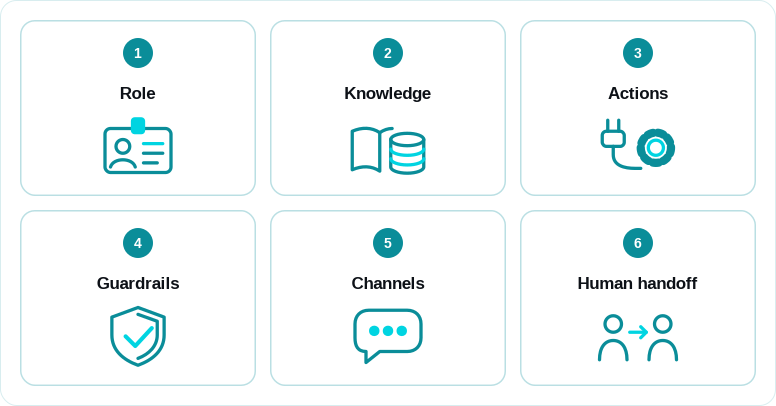
“Digital labor” is a slogan. It doesn’t tell you the job, the data, the writes, the refusals, or who picks up when the model should stop. Before any Agentforce implementation starts in Agentforce Builder, put these six items on a whiteboard: Role, Knowledge, Actions, Guardrails, Channels, and a Human Handoff.
This list is SI methodology for implementation. Agentforce supplies the primitives — you still decide how they fit a production agent. Summer ’26 is current GA; Multi-Agent Orchestration (connected subagents) is Beta. The goal: don’t design an agent without first addressing all six decisions.
01 - Role: what the agent is for.
Decide. One job, in one sentence. Who it serves. What it must never pretend to own. Agent Script’s config block holds the role and a description of goals and purpose. Pick a type: AgentforceServiceAgent or AgentforceEmployeeAgent.
Inside that job sit subagents. Beginning in April 2026, topics were renamed to subagents. A subagent is a job the agent can do: description, actions, reasoning instructions. The start_agent block (Agent Router in Canvas) classifies each utterance and routes.
Done looks like
A one-line job. A named type. A short roster of subagents with no overlapping descriptions. Required welcome and error messages. A written “out of scope” list the router can honor.
Common SI failure
A 40-line persona and no job. The model invents work you never funded. If the room cannot say what this agent will refuse, you do not have a role.
02 - Knowledge: what it is allowed to know.

Decide. Where a correct answer comes from, and what happens when retrieval is empty. Public grounding paths include CRM context, Salesforce Knowledge, file libraries, website content indexed in Data 360, and custom retrievers. (Data Cloud was renamed Data 360 on 14 October 2025; the functionality did not change.)
Agentforce Data Libraries turn unstructured content into searchable indexes. A retriever returns passages to the model at run time. Apex citations can label Knowledge, PDFs, and external URLs. If you need Data Libraries, develop in a sandbox that can connect to Data 360.
Done looks like
Named sources. An active retriever. Citations on or off as a decision. A fallback when nothing relevant is retrieved: say so, ask a clarifying question, or escalate. Never guess.
Common SI failure
“Ground it on the org.” That is not a source. If you cannot name where a right answer lives, you cannot name where a wrong one came from.
03 - Actions: what it is allowed to do.
Decide. Every lookup, write, and side effect is an Agentforce action. Public surfaces include Flow, Apex REST, AuraEnabled methods, Apex InvocableMethod, named queries, and prompt templates. Agent Script can run an action every time a subagent runs, or expose it as a tool the LLM may choose. You can chain actions and set require_user_confirmation before an action executes.
Actions have to reach a system of record. That is an integration problem. In this meeting, design the contract: inputs, outputs, idempotency, failure. Do not design the bus.
| Action name | Target | Required inputs | Confirmation | Owner |
|---|---|---|---|---|
| Look up order | TargetOrder Mgmt | Required inputsOrder ID | ConfirmationNo | OwnerCommerce |
| Issue refund | TargetPayments | Required inputsOrder ID, amount | ConfirmationYes | OwnerFinance |
Done looks like
The action table, filled in. Named queries activated in the API Catalog. Users who execute them have read access to the queried objects.
Common SI failure
A chatty agent with no actions, then a next sprint labeled “automation.” Conversation is not work. If the agent cannot read or write a record on purpose, it is a demo.
04 - Guardrails: what it must not do.


Decide. Three layers, not one checkbox.
- Platform floor – Trust Layer: The Einstein Trust Layer provides grounding in CRM data, masking of sensitive data, toxicity detection, audit trail and feedback, and zero data retention agreements with third-party LLM partners. Salesforce also states you are responsible for LLM-generated content you share, and recommends a human check for most external-facing use cases.
- Data floor – Permissions: An agent runs as a Salesforce user. That user’s permissions grant or deny access to records and Apex. Service agents require
default_agent_userin the access block. Start with least privilege. - Behavior floor – Script: Agent Script lets you mark where the LLM may reason and where the agent must execute deterministically: if/else, forced action sequence, forced subagent transition. Put high-risk steps on the deterministic path. Write “must not” in instructions, then enforce it with confirmation and permissions.
Done looks like
A named agent user and permission set. A “must not” list. Deterministic paths for money, entitlement, and outbound send. A review path for customer-facing answers.
Common SI failure
Treating Trust Layer as a completed risk review. Masking and toxicity detection do not decide whether this agent may issue a credit. You do.
05 - Channels: where it actually runs.
Decide. One primary surface for v1. Only list a channel if a public Help or developer page names it for this agent type. Public docs name:
- Slack: Build in Salesforce, add a Slack connection. Employee Agent templates exist; Service Agents need explicit member access.
- Enhanced Chat v2: Service agents on external web chat, via a messaging connection block.
- Headless: Agent API and custom connections.
- Mobile: Agentforce Mobile SDK; Enhanced In-App Chat, including escalation that keeps conversation context.
Done looks like
Channel, agent type, and access model on one line. Identity mapping done. Someone owns the experience after publishing.
Common SI failure
“We’ll put it everywhere.” Each surface has a different identity, confirmation UX, and escalation plumbing. One production agent on one surface beats a half-wired presence on five.
06 - Human handoff: who takes the session when the agent should stop.

Decide. When to stop, who receives the thread, and what context travels with it. Skip this and you have a kiosk with no attendant.
Agent Script’s utils.escalate hands off to a human service rep. It needs an active Omni-Channel connection: a connection messaging block with outbound_route_type and outbound_route_name pointing at an Omni-Channel flow. You can gate escalate on a variable (business hours is the documented pattern). utils.end_session ends the conversation when the job is done or the utterance is out of bounds.
Done looks like
A real queue with capacity. An escalation message the customer will see. A test in which a human receives the session with enough context to continue. An “I want a person” path that does not loop.
Common SI failure
An escalate tool with nobody behind it. The agent says it is connecting you. The queue is empty. That is not a soft landing. That is an incident.
If the room cannot answer all six, you are not ready to build.
This is not a go-live checklist. It is a build-readiness checklist. Open Builder after the whiteboard is full, not before. The outcome is usage: sessions that complete the job, actions that hit the record, escalations that land on a person.
Connected subagents can wait. Get one agent through these six decisions. Then talk about the second.
07 - How API People can help.
API People is a Salesforce and MuleSoft integration partner focused on banks, credit unions, and fintechs. Our team brings deep expertise in Financial Services Cloud, OmniStudio, Agentforce, Data 360, Headless 360, MuleSoft, and API-led connectivity. We connect legacy cores (Fiserv, Jack Henry, FIS, and others) so the agent’s actions actually reach the system of record.
Where we typically land
The six decisions remain yours. We help you make them complete, then implement the actions, grounding, and escalation so the agent is production-ready rather than conversational theater.
Role. Knowledge. Actions. Guardrails. Channels. Human handoff.
Fill the whiteboard first. Can your team answer all six for the agent you’re about to build?
Reach out →FAQs
1. What should you decide before starting an Agentforce implementation?
Six things: role, knowledge, actions, guardrails, channels, and human handoff. Agentforce supplies the primitives, but every Agentforce implementation still has to decide how they fit a production agent. If the room cannot answer all six, you are not ready to build.
2. Is the Einstein Trust Layer enough for guardrails in an Agentforce implementation?
No. The Trust Layer is the platform floor: grounding, masking, toxicity detection, and audit trail. A production Agentforce implementation also needs least-privilege permissions and deterministic Agent Script paths for money, entitlement, and outbound send.
3. How does human handoff work in an Agentforce implementation?
Agent Script’s utils.escalate hands the session to a human service rep through an active Omni-Channel connection. It only works if a real queue with capacity sits behind it, and the context travels with the thread.
4. Which channel should an Agentforce implementation launch on?
One primary surface for v1, with identity mapping done and someone who owns the experience after publishing. Each surface has its own identity, confirmation UX, and escalation plumbing — one agent on one surface beats a half-wired presence on five.
Source
Agentforce fundamentals
- Get started with Agentforce (…/agentforce/guide/get-started.html).
- Agents — agent types and subagents (…/agentforce/guide/get-started-agents.html).
- Agent actions — Flow, Apex, named queries, prompt templates (…/agentforce/guide/get-started-actions.html).
Agent Script
- Agent Script overview (…/agentforce/guide/agent-script.html).
- Agent Script blocks — config, start_agent, access, connection (…/agentforce/guide/ascript-blocks.html).
- Agent Script reference — actions and require_user_confirmation (…/agentforce/guide/ascript-ref-actions.html).
- Agent Script reference — utils.escalate and utils.end_session (…/agentforce/guide/ascript-ref-utils.html).
Knowledge, trust and actions
- Einstein Trust Layer (…/agentforce/guide/trust.html).
- Agentforce Data Libraries (…/agentforce/guide/adl.html).
- Citations (…/agentforce/guide/citations.html).
- Named queries and the API Catalog (…/agentforce/guide/agent-namedquery.html).
- Apex actions — InvocableMethod and AuraEnabled (…/agentforce/guide/agent-apex.html).
- Set up the development environment (…/agentforce/guide/agent-dx-set-up-env.html).
- Ground Agentforce on website content — search index and retriever (…/ground-agentforce-on-website/guide/aes-create-search-index-and-retriever.html).
- Data 360 developer guide — get started (…/data-cloud-dev/guide/dc-get-started.html).
Channels
- Enhanced Chat v2 for Service agents (…/agentforce/guide/get-started-enhanced-chat.html).
- Slack Help — Set up and manage Agentforce in Slack (slack.com/help/articles/36218109305875).
Read it offline — get the full PDF
Fill in two fields and the download starts right here.
- Every figure and diagram at full resolution
- All sources, linked and cited
Talk to an integration expert
About your environment — no pitch deck required.

Naveen Nadimpalli
Naveen is a results-driven IT leader and integration architect with more than 20 years of experience delivering digital transformation across diverse industries. He brings deep expertise in Salesforce, Financial Services Cloud (FSC), OmniStudio, MuleSoft, enterprise integration, and client engagement.
He specializes in leading end-to-end transformation programs and building scalable, secure, and high-impact solutions that align technology with business objectives. Naveen is also passionate about AI security, agentic AI, and the Model Context Protocol (MCP), and regularly shares practical insights on secure, AI-assisted development.


