
 Workato
 Azure
Azure MuleSoft
 Salesforce
 AWS
AWS


02 — The liability moved to humans
The biggest shift of 2026 isn’t technical. Per Baker McKenzie’s July 2026 analysis of U.S. law, accountability for what autonomous agents do runs to the humans and entities behind it — organizations cannot claim AI autonomy as a liability defense. “The AI decided that on its own” will not survive contact with a courtroom, a regulator, or your board. Your peers have also taken notice. AI risk disclosure among S&P 500 companies jumped from 12% in 2023 to 72% in 2025 (Harvard Law Forum / The Conference Board), and the Conference Board’s April 2026 update puts it at 83% when compared to December 2025 data. The SEC’s Investor Advisory Committee formally recommended AI risk disclosure in December 2025. If you’re still in the non-disclosing minority, you’re the outlier when something goes wrong. The costs also run away before anyone notices. Gartner predicts over 40% of agentic AI projects will be cancelled by the end of 2027, citing escalating costs, unclear business value, and inadequate risk controls — governance failures, not model failures. Uber exhausted its entire 2026 Claude Code budget by April, as the tool spread to roughly 5,000 engineers (Forbes, May 2026). That is what “no budget guardrail at machine speed” looks like.
 03 — This isn’t an AI problem
It’s a governance problem wearing an AI costume, and we solved this exact shape with APIs a decade ago: the winners didn’t ban APIs, they governed them. What’s genuinely new is the failure speed.Traditional application
Deterministic
Acts under one identity
Waits for a human to approve consequential actions
AI agent
Reasons
Picks tools on the fly, fans out across trust domains
Acts first
More on these incidents — and what containment actually requires — is coming in Part 2 of this series.
Figure 4 · What good looks like
The control plane: four controls, outside the agent, on every call
Every authoritative framework — NIST/CSA’s agentic profile, Forrester AEGIS, Gartner — converges on the same four controls, and all four share one property: they live at a layer the agent cannot rewrite.
See everything
A live inventory of every agent, its owner, and what it can touch.
Gate every action
One chokepoint enforcing identity, policy, and PII rules at call time.
Propagate identity
The end-user’s identity rides every hop, not a “god-mode” service account.
Watch and cap
Real-time telemetry and enforced consumption limits.
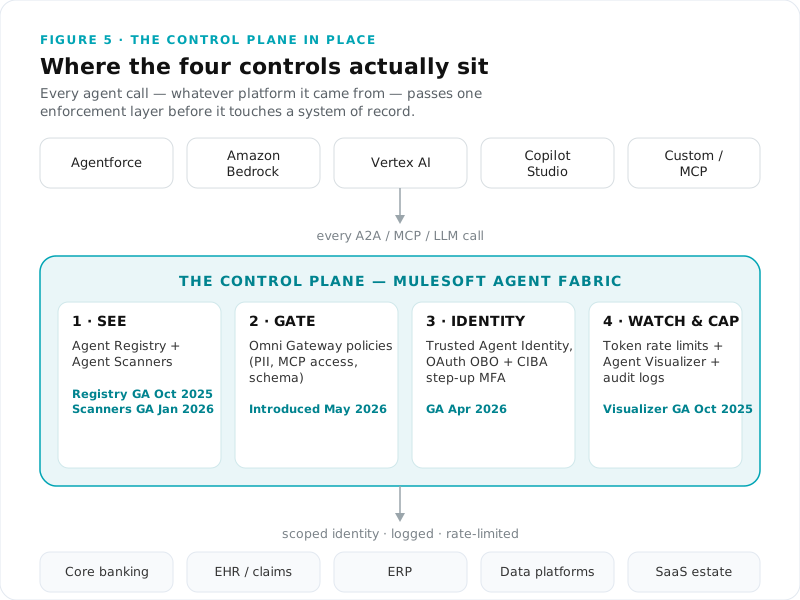
Controls live outside the agent — a registry it can’t hide from, a gateway it can’t reconfigure, an identity it can’t escalate.
Read it offline — get the full PDF
Fill in two fields and the download starts right here.
- Every figure and diagram at full resolution
- All sources, linked and cited
Talk to an integration expert
About your environment — no pitch deck required.


