Ready To Modernize Your Architecture?
Discuss your current infrastructure and scalability goals with our integration experts.

Workato Skills enable reusable, authenticated workflows across Genies and external AI clients, eliminating duplicated integrations and simplifying enterprise maintenance.
This is the last in a four-part series on what we built inside our own Workato workspace. Parts 1 through 3 showed the same handful of Skills doing real work in three different places — a Slack conversation, a team of specialist Genies, and an external AI client. This article is about the piece none of those articles could have happened without: the Skill itself.
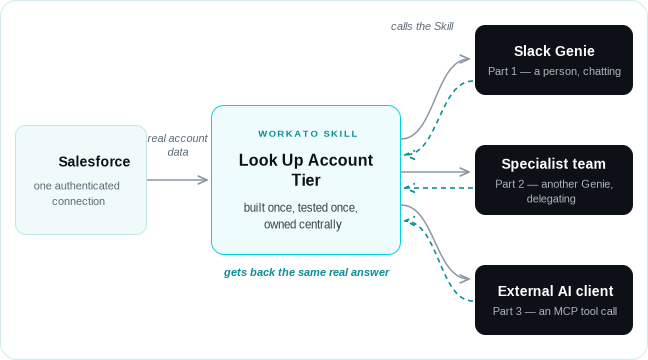
Here’s something we didn’t call out at the time, because it was easy to miss in the moment: we did not build “look up an account’s support tier” three separate times for three separate articles. We built it once. The Slack Genie in Part 1 called it. The Account Specialist in Part 2 called it. The external AI client in Part 3 called the same one again, through a completely different door. One Skill, one connection to Salesforce, three unrelated consumers.
That’s not a coincidence, and it’s not a shortcut we happened to get lucky with. It’s the actual point of building Skills as their own thing, rather than writing one-off logic into whichever assistant needs it this week.
Workato’s own documentation describes a Skill in exactly those connective terms: you create a skill to define a workflow that an AI agent can invoke — a Genie calls it directly, and an MCP server exposes that same skill as a tool for an external AI client to call. That’s the throughline this whole series has been describing without naming it outright.
Anyone can wire an AI assistant up to a system with a quick, purpose-built script. The problem shows up the second a business wants a different assistant to do something similar — a script written for one bot rarely transfers cleanly to the next one, so the same integration gets rebuilt, slightly differently, every time.
A Skill, built the way we built ours, is deliberately narrower and more disciplined than that. It does one clearly named thing — “look up an account,” not “do whatever Salesforce-related task comes up.” It carries its own authenticated connection, so nothing consuming it needs its own credentials or its own understanding of the underlying system. And it’s described in plain language an AI system can match against, which is exactly what let three unrelated consumers find and use it correctly without being told how.
Across this series, that one Skill answered a customer in Slack, answered a specialist Genie delegated to by the Lead Genie, and answered an external AI client that had never seen this build before — all without a single change to the Skill itself. When we later added a new consumer, the work was in connecting a new front door, not in re-solving “how do I safely check Salesforce.”
Here’s the same question — “what’s the support tier for Meridian Health Group?” — answered three different ways across this series, through three unrelated front doors, off the same underlying Skill and the same live Salesforce record. Every one of these still goes through delegation — the Lead Genie never holds the Skill itself — the difference is how many specialists a single message calls on at once, and who’s asking in the first place.
The first time you build a Skill this way, it isn’t obviously faster than a quick script. The payoff shows up the second, third, and fourth time a business needs that same capability somewhere new — a different assistant, a different channel, a different team — and the answer is “point it at what already exists,” not “build it again.”
That’s the throughline across all four parts of this series: a Genie that’s only useful because it’s grounded in real Skills, a team of Genies that only works because each Skill is scoped to one specialist, an MCP server that only makes sense because the Skills underneath it don’t care who’s calling — and now, Skills that only pay off at enterprise scale because they were built to be reused, not rebuilt.
Four articles, one build. A Genie that checks real systems instead of guessing. A team of specialists that genuinely delegate rather than fake it. A door open to any AI client, not just one chat app. And underneath all three, the same small set of Workato Skills, built once, carrying the load for every one of them. That’s not a proof of concept for what AI assistants could someday do inside a business — it’s what we watched one actually do, built on Workato, end to end.
Want a Workato Genie working on your real systems, not a demo? Start the conversation.
Reach out →That’s exactly what this pattern avoids. A well-built Workato Skill is consumed by whatever needs it — a Genie, a specialist, an external AI client — without being rebuilt for each one.
Narrow scope, a plain-English description an AI system can match against, its own tested and authenticated connection, and clear ownership — someone responsible for it when the underlying system changes, not whoever happened to write it first.
Whoever owns that underlying connection maintains the Workato Skill in one place. Because every consumer calls the same Skill rather than its own copy of the logic, a fix made once reaches every assistant using it — instead of hunting down every place that logic got duplicated.
It’s worth designing for from the start, even then. The cost of building Workato Skills properly the first time is small; the cost of retrofitting scattered, one-off integrations later, once a business has three or four assistants, is not.
Fill in two fields and the download starts right here.
About your environment — no pitch deck required.
Senior Integration Engineer with 13+ years of software engineering and enterprise integration experience, specializing in MuleSoft, API architecture, cloud integration, and integration modernization. Experienced in building API and serverless solutions using FastAPI, Python, and AWS services including Lambda, S3, SQS, SNS, DynamoDB, IAM, and CloudWatch, with Infrastructure as Code exposure using Terraform. Recently expanded into AI integration through hands-on experience with MuleSoft Agent Fabric concepts, including Agent Network, Model Context Protocol (MCP), Agent-to-Agent (A2A) communication, AI/agent governance, and LLM integration. Experienced with Anthropic Claude and OpenAI in development and POC workflows. Brings a strong enterprise integration foundation for connecting AI agents and LLMs with APIs, business systems, and cloud services. Targeting AI Integration Engineer / Agentic AI Integration roles while continuing to leverage deep MuleSoft and enterprise API expertise.
Insights, product releases and event invites for technology leaders — straight to your inbox.
Subscribe now to keep reading and get access to the full archive.